
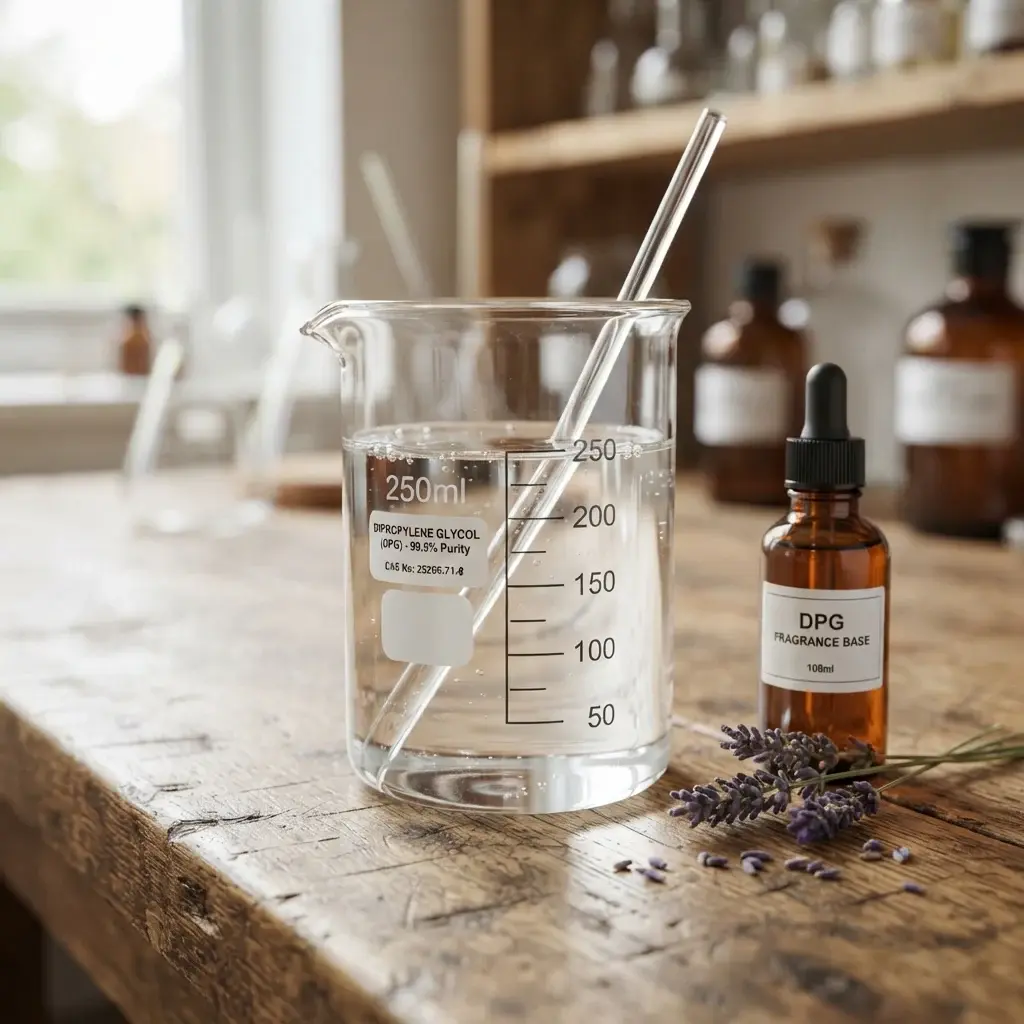
Dipropylene Glycol (DPG) | Cosmetic Grade Solvent & Fragrance Carrier
From ₦5,500.00Select size in litres to see the exact price.
A clear, low-odour liquid that helps ingredients blend smoothly, keeps formulas stable, adds light moisture, and carries fragrance evenly.
✓ No account needed. Add to cart → Checkout → Done.
Description
Dipropylene Glycol, or DPG, is a clear, nearly odourless liquid that mixes easily with water. It is used in skincare, haircare, fragrance, and personal-care products to help other ingredients blend, stay stable, and feel good when applied. it is a water-miscible liquid that helps bring a formula together. DPG works behind the scenes to improve ingredient solubility, product consistency, and fragrance delivery.
What It Does (Benefits)
- Helps ingredients mix: DPG helps dissolve ingredients that may not blend easily with water, such as some fragrance materials or plant extracts.
- Carries fragrance: It helps fragrance spread evenly through a product and can help the scent last longer.
- Helps hold moisture: DPG is a humectant, which means it helps the product hold onto water and can leave skin feeling less dry.
- Improves texture: It helps make creams, lotions, and other products feel smooth and easy to spread.
- Keeps formulas stable: It helps ingredients stay evenly mixed instead of separating.
Product Specifications
INCI name: Dipropylene Glycol
Ingredient type: Glycol / multifunctional formulation ingredient
Grade: Cosmetic grade
Common name: DPG
CAS number: 25265-71-8
Appearance: Clear, colorless liquid
Smell: Very low odor / practically odorless
Solubility: Fully miscible with water
Functions: Solvent, fragrance carrier, humectant, viscosity modifier
Typical pH in formula: Works across a broad practical pH range; a 50% DPG solution is around pH 5.0–7.5
Storage: Keep tightly closed, dry, cool, and away from direct sunlight; store below 40°C download.basf+1
Shelf life: 18 months, when stored correctly
Types of Products You’ll Find It In
DPG is commonly used in:
- Moisturizers, serums, and toners
- Cleansers and body washes
- Shampoos and conditioners
- Perfumes, body sprays, and scented lotions
- Makeup and deodorants
It is especially useful in products with fragrance because it helps carry and distribute the scent.
Why Formulators Use It
DPG is a practical formulation ingredient rather than a headline active. It helps create products that feel pleasant to use, blend well, remain stable, and deliver fragrance or other ingredients evenly.
Its water compatibility, low odour, and relatively low skin-irritation potential make it useful across many cosmetic applications.
Formulation Guide (How to Use Dipropylene Glycol)
DPG is easy to work with because it mixes well with water and many fragrance materials. Add it during the water phase or dissolve it with the ingredients you want it to carry; it does not usually need heating.
Start low, especially in leave-on skincare products, then increase only if the formula needs more solubilizing power or a smoother feel.
Typical Usage Rates for DPG
Facial serum, toner, or moisturizer: 1-5%. Here DPG helps dissolve ingredients, adds light moisture, and improves skin feel.
Body lotion or cream: 1-5% DPG helps improves texture and helps keep the formula stable
Shampoo, conditioner, or body wash: 1-5% It helps dissolve fragrance and other additives; improves product feel
Deodorant or body spray: 1% in some body sprays and mists. And up to 20% in some. Here DPG helps carry fragrance. *10% to 15% in deodorant gels, and 24% to 55% in solid deodorant sticks.
Perfume or fragrance oil dilution: 10-30% DPG in the dilution. It dilutes strong aroma materials for easier handling and more accurate blending
Reed diffuser or room fragrance: 5-80%. Here, DPG acts as the main carrier/diluent for fragrance oils.
How to Add It
- For skincare: Add DPG to the water phase before heating, or add it during the cooling phase if it is being used to dissolve a heat-sensitive ingredient.
- For fragrance oils: Add the fragrance oil to DPG slowly while stirring until the mixture is clear.
- For a perfume dilution: Start with a 10% fragrance-in-DPG dilution, then adjust based on the strength and behavior of the aroma materials.
- For emulsions: Add DPG before or during emulsification, depending on whether you are using it to dissolve an ingredient or improve the final texture.
- Test the finished formula: Check clarity, scent strength, viscosity, stability, and how the product feels on skin.
Formulation Tips (How to Use DPG)
- Start at 1–3% in facial skincare if you are unsure; increase to 5% only if needed.
- Use DPG when a fragrance oil or extract will not dissolve evenly in the water phase.
- Do not rely on DPG alone to solubilize every oil. Test each fragrance or active because solubility varies.
- Avoid relying on DPG in oil-only or wax-based products such as candles, wax melts, massage oils, and some lip products, where it may not dissolve well.
- Keep the total glycol load in mind. Too much DPG can make a product feel sticky or change its viscosity.
- Always run stability and microbial challenge testing before selling a finished product.
Safety & Handling
- Wear gloves and safety glasses when handling the raw material.
- Work in a well-ventilated area.
- Keep the container tightly closed and away from heat, flames, and ignition sources.
- Avoid contact with eyes and prolonged skin contact.
- Store in a cool, dry place, ideally below 40°C, and protect it from moisture and light.
Is It Safe?
The Cosmetic Ingredient Review (CIR) Expert Panel has concluded that Dipropylene Glycol is safe as used in cosmetics. As with any ingredient, some people may be sensitive to it, especially if they already react to glycols.
If you are trying a new product, do a patch test first. If you notice redness, itching, or irritation, stop using it and speak with a dermatologist.
Dipropylene Glycol vs. Propylene Glycol
- Dipropylene Glycol (DPG): A water-soluble glycol. It dissolves ingredients, carries fragrance, and improves texture
- Propylene Glycol (PG): A smaller glycol. It acts as a solvent and humectant in cosmetics
Both ingredients are related ingredients, but they are not the same. A formulator may choose one over the other based on how it affects the product’s feel, scent, stability, and ingredient compatibility.
FAQs
Is Dipropylene Glycol the same as propylene glycol?
No. Both are glycols used in cosmetics, but they are distinct ingredients with different molecular structures and formulation properties. DPG is often selected for its solvent, fragrance-carrying, and texture-controlling benefits.
Is DPG a moisturizer?
It helps hold moisture in a formula, but it is not usually the main moisturizing ingredient. It works alongside ingredients such as glycerin, hyaluronic acid, and oils.
Does DPG have a scent?
It has very little to no scent, which is one reason it is popular in fragrance products.
Is DPG good for sensitive skin?
It can be suitable for many people, but everyone’s skin is different. Check the full ingredient list and patch test before using; stop using the product if irritation occurs. Published human data show that using products with a high-concentration of DPG can cause irritation in some individuals.
Is DPG natural?
No. DPG is a synthetic ingredient, meaning it is made through a chemical process rather than directly from a plant or mineral.
Is Dipropylene Glycol safe in skincare?
The CIR Expert Panel has concluded that DPG is safe as used in cosmetics. Product safety still depends on the complete formula, concentration, and intended use.
Only logged in customers who have purchased this product may leave a review.
You may also like…
- Cosmetic Ingredients, Liquid Ingredients, Preservatives & Boosters
Propanediol
- From ₦1,700.00
- Select options This product has multiple variants. The options may be chosen on the product page
- Candle Making Ingredients
Soy Wax Flakes (for Candle Making)
- From ₦4,500.00
- Select options This product has multiple variants. The options may be chosen on the product page
- Cosmetic Ingredients, Preservatives & Boosters
Liquid Germall Plus (Preservative)
- From ₦3,800.00
- Select options This product has multiple variants. The options may be chosen on the product page


Related products
- Clays & Exfoliants, Cosmetic Ingredients, Powders & Flowers
Bentonite Clay Powder
- From ₦2,300.00
- Select options This product has multiple variants. The options may be chosen on the product page
- Butters, Cosmetic Ingredients, Oils & Butters
Mango Butter (Unrefined)
- From ₦2,500.00
- Select options This product has multiple variants. The options may be chosen on the product page
- Cosmetic Ingredients, Emulsifiers & Thickeners
SOFT & SILKY EMULSIFYING WAX | Non-Ionic Plant-Based Emulsifier
- From ₦2,500.00
- Select options This product has multiple variants. The options may be chosen on the product page


Reviews
There are no reviews yet.