You’re making a body butter, a hair mist, a face cream or a homemade aloe vera gel. The ingredients are laid out and the formula/ recipe is open. You’re nearly ready to start.
Then the doubt creeps in. One person says vitamin E will preserve it. Another says a few drops of tea tree oil will do the job. A third says butters and oils never need preservatives at all.
They can’t all be right, so which advice do you follow?
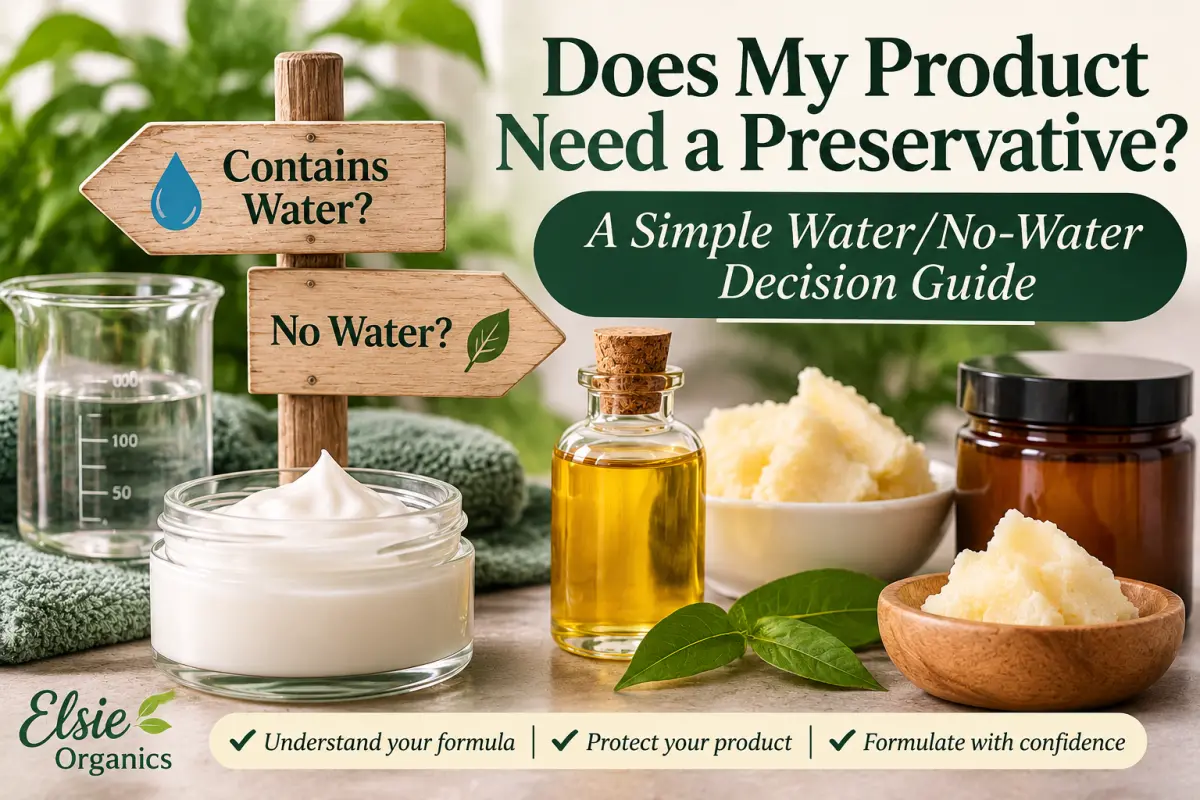
The quick answer: if your formulation or recipe contains water, or anything made with water, it needs a proper preservative. If it’s truly water-free, it usually doesn’t need a preservative, though there are a few catches. The rest of this guide explains why, so you can decide with confidence.
First, What Does a Preservative Actually Do?
A cosmetic preservative protects your product from bacteria, yeasts and moulds. These can get in during the making, during storage and every single time someone uses the product.
Picture a jar of homemade conditioner in a warm or damp bathroom. Each time it’s opened, a little more of the outside world gets in. If you scoop it with wet fingers, you also add the one thing microorganisms need most: water. Given the right conditions, they multiply fast.
The frightening part is that a contaminated product doesn’t always look or smell spoiled. You may notice a strange smell, a texture change or visible mould, but contamination can be present long before any of that shows.
What that means for you: a preservative isn’t about making a product last for ever. It’s about keeping it safe to use, for as long as you say it’s good for. For example, if you say the product should be good for 6 months, then formulate it to stay safe for 6 months.
Does Your Product Contain Water? Start Here.
Ask yourself one question: does my formulation or ingredients contain water, or anything made with water? Let’s look at it from each angle:
If it contains water
You’ll need a suitable broad-spectrum preservative, unless a proper microbiological risk assessment shows the finished product is low-risk. Examples of products that usually need preservatives include:
- Face creams and body lotions
- Hair conditioners and leave-in conditioners
- Water-based hair mists and sprays
- Aloe vera gels
- Toners and water-based serums
- Shampoos and liquid cleansers
Water also hides in ingredients you may not think of as “water”, such as:
- Aloe vera juice or gel
- Rose water and other hydrosols
- Herbal infusions and teas
- Distilled water
Even a small amount of water doesn't make a recipe safe. As long as there is water in the formula, it counts.
If it doesn’t contains water
A genuinely anhydrous product (one made without any water) often doesn’t need a conventional antimicrobial preservative. That includes facial oils, body oils, oil-only haircare blends, pure body butters, oil-based balms and salves. Without water, microorganisms struggle to multiply. A product with no water gives them very little to work with.
What that means for you: check your ingredient list, line by line. If you can’t point to a single water-based ingredient, you’re probably in anhydrous territory.
One idea is worth knowing at this point. Professional formulators think in terms of water activity, which is how much water is actually available to microorganisms, not just how much is present. Honey, for example, contains water but resists spoilage because that water is tightly bound. That’s why a simple water/no-water check is a very good starting point, but not the whole story.
Body Butters: Do They Need a Preservative?
A properly made anhydrous body butter, with only butters, oils and waxes, generally doesn’t need a preservative. Take a simple blend of shea butter, cocoa butter, sweet almond oil and vitamin E. There’s no water anywhere in it, so there’s very little for microbes to use.
This is also where vitamin E gets misunderstood. It slows down oxidation, which is what makes oils and butters go rancid. It doesn’t protect against bacteria, yeasts or moulds. It’s a different job entirely.
If you’re stocking up for your own butters, you’ll find shea butter, cocoa butter and carrier oils in our shop.
What about whipped butters?
Whipping adds air, not water, so it doesn’t change whether you need a preservative. What can change the picture is how the jar is used. If someone dips wet fingers into it after a shower, water gets in. A clean, dry spatula, a closed lid and a cool, dry spot make a real difference.
And remember that butters and oils can still go rancid, even when microbes aren’t the problem. Anhydrous doesn’t mean indestructible.
Two Risks Many Beginners Miss
Heat and humidity: If you’re making products in a warm, humid climate like ours (Nigeria), a jar of lotion or cream sitting in a hot room is under more pressure than one in a cool cupboard abroad. Even a water-free product should be kept somewhere cool, dry and out of direct sun. Also, humid-season storage deserves extra care.
Infused oils: If you steep/ infuse dried herbs or botanical powders in oil, make sure that the herbs are completely dry and strain them well. Any single moisture that comes in contact with the plant material can introduce water into a finished product you thought was anhydrous. This matters for anyone making herbal hair oils, for example with ayurvedic herbs.
Oil and Water Together: Why Emulsifiers Aren’t Enough
Now imagine a face cream made with distilled water, shea butter, sweet almond oil and an emulsifier. Oil and water naturally separate, so the emulsifier holds them together in one smooth cream.
But an emulsifier is not a preservative. It keeps the cream from splitting. It does nothing to stop bacteria growing in it.
So any emulsion containing water needs both an emulsifier and a preservative system chosen to suit the recipe/ formula’s pH, ingredients and the recommended usage guide. Part 2 of this guide covers how to choose one.
If you’re formulating something with water in it, you’ll find preservatives and formulation essentials in our shop. Each product page lists the usage guidance, so you can check what suits your formulation/ recipe before you buy.
What About Tea Tree and Other Essential Oils?
Essential oils have antimicrobial properties, which is why the advice sounds convincing. The problem is that at the levels that are safe on skin, essential oils don’t give reliable, broad protection against the full range of bacteria, yeasts and moulds in a water-based product. Using more to compensate raises the risk of irritation without making the product dependable.
What that means for you: use essential oils for fragrance or their other benefits, not as your only line of defence.
Does Refrigerating It Mean I Can Skip the Preservative?
No. The cold slows some microorganisms but doesn’t reliably stop them, and a poorly preserved water-based product isn’t made safe by keeping it in the fridge. If you’re making products for other people or to sell, you need proper preservation and storage, not refrigeration as a shortcut.
Frequently Asked Questions
Yes, if it is genuinely anhydrous, such as facial oils, body oils and oil-only balms. Anything containing water generally needs a preservative unless a documented risk assessment shows it is low-risk.”
Pure shea butter contains no water, so it does not usually need a conventional antimicrobial preservative. It can still oxidise over time, so store it well and consider an antioxidant.”
If a scrub is only oil and sugar, keep it dry and use a clean scoop. If any water-based ingredient is in the recipe, it should be preserved. Because scrubs are used in wet bathrooms, a scoop and a tight lid matter either way.
Yes. Whether it is shop-bought gel or juice you have added yourself, it contains water, so it needs appropriate preservation. Check your supplier’s guidance for what suits that ingredient.
No. Vitamin E slows oxidation in oils and butters. It does not protect against bacteria, yeasts or moulds.
Look for changes in smell, colour, texture or appearance. However, a product can be contaminated without any of these signs, so do not assume it is safe just because it seems fine. If you are selling, proper testing matters.
So, Which Advice Should You Follow?
Back to where we started. Vitamin E, tea tree oil and “butters never need a preservative” – all contain a small piece of truth, but none of them replaces the one question that matters: is there water in your formula?
- Water in the recipe? Preserve it properly.
- No water at all? You likely don’t need a conventional preservative, but still think about oxidation, storage and how the jar will be used.
- The full picture counts: your formula, your packaging and the way it will be handled.
Take the time to understand what each ingredient does and why it’s there. You’ll make safer products, avoid common mistakes and formulate with far more confidence.
Browse our carrier oils and butters, preservatives and formulation ingredients when you’re ready for your next batch.
Happy formulating!
References and Further Reading
For readers who want to explore the science and safety guidance behind cosmetic preservation:
- U.S. Food and Drug Administration (FDA) – Microbiological Safety and Cosmetics. An overview of how cosmetics can become contaminated and the factors that contribute to microbial safety.
- ISO 29621:2017 – Cosmetics: Microbiology, Guidelines for the Risk Assessment and Identification of Microbiologically Low-Risk Products. Guidance on assessing the microbiological risk of cosmetic products, including the role of water activity and other formulation characteristics.
- ISO 11930:2019 – Cosmetics: Microbiology, Evaluation of the Antimicrobial Protection of a Cosmetic Product. An international standard covering the evaluation of a cosmetic product’s antimicrobial protection, including preservation efficacy testing.
