
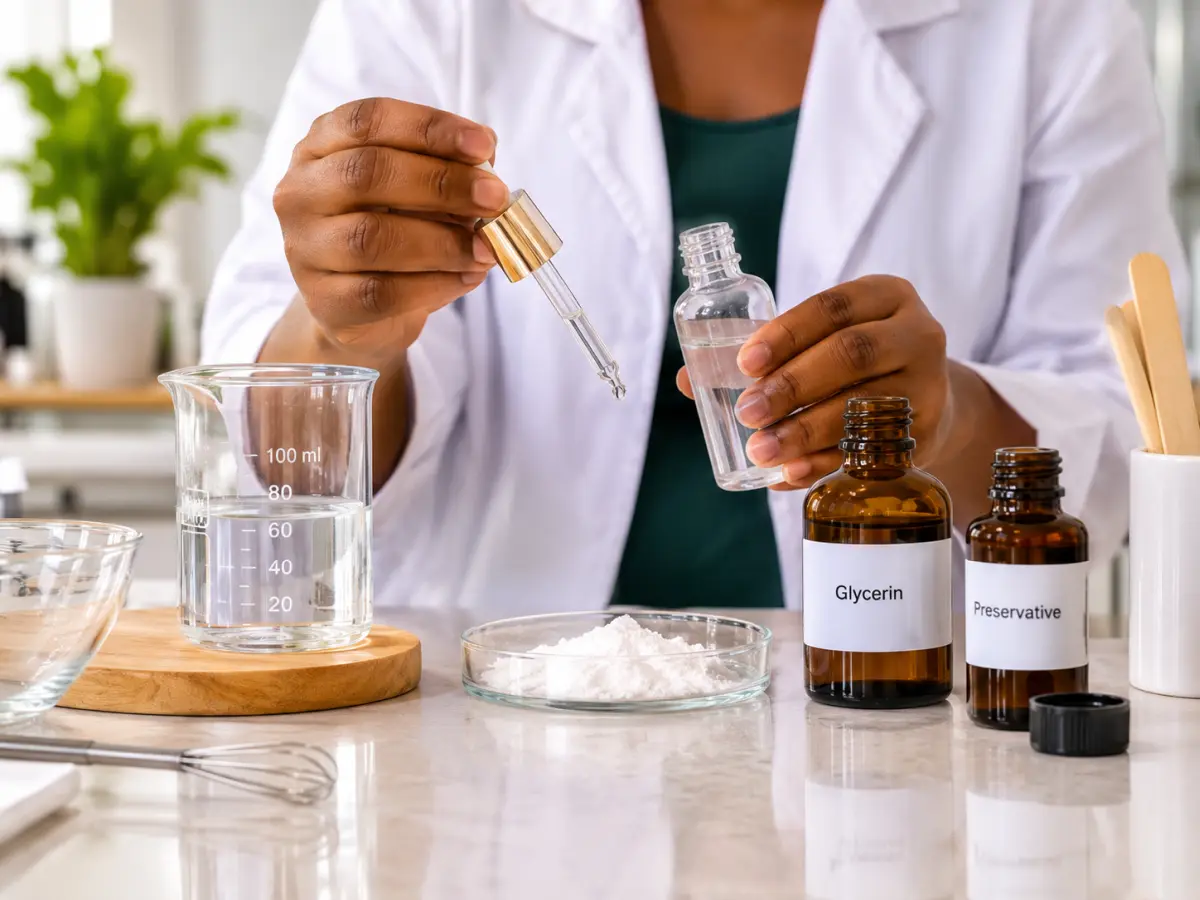
The jar arrives. It’s a plain white powder, and you’ve got a scale, a bottle of distilled water and a dozen questions. How much do you use? Does it go in hot or cold? Will it go gritty? Is it going to make your skin tingle? And does it work in hair products too, or only on the face?
Here’s the good news: niacinamide is one of the most forgiving ingredients you can learn on. The confusion around it is what’s complicated, and by the end of this guide you’ll have the answers and a recipe to try.
Whether you’re making for yourself or building products to sell, read it straight through if you’re new to formulating. If you’ve been at this a while, skip ahead to the pH, quality and selling sections.
Niacinamide powder at a glance
| INCI name | Niacinamide |
| Also called | Nicotinamide, vitamin B3 |
| CAS number | 98-92-0 |
| Form | Fine white powder |
| Dissolves in | Water |
| Goes into | The water phase, or the cool-down stage |
| Typical use rate | 1–5% (check your spec sheet) |
| Working pH | About 5–7 |
Words you’ll see in this guide
- INCI: the standard ingredient name used on labels.
- Water phase: the water-based part of your formula, where water-soluble ingredients go.
- Cool-down stage: the point late in making an emulsion, once it has cooled below about 40°C, when heat-sensitive ingredients go in.
- Humectant: an ingredient that draws in moisture, like glycerin.
- Preservative: what keeps a water-based product safe from bacteria and mould. It’s not optional.
- pH: how acidic or alkaline a product is, on a scale where 7 is neutral.
What is niacinamide powder?
Niacinamide is the amide form of vitamin B3. It’s usually made synthetically, with the same chemical structure as the niacinamide found in nature, and it arrives as a fine white powder that dissolves easily in water.
It’s not the same as niacin. They’re related, but niacin is the form linked to flushing, and confusing the two is behind much of the worry online.
In plain terms: you’re working with a water-soluble, stable, widely used ingredient. It’s an easy first active, and one that experienced formulators keep coming back to.
Why makers reach for it
“My skin gets shiny by noon”: a more balanced look
You’ve probably tried products that strip you dry and then wondered why your skin felt worse. Niacinamide is used in cosmetics to help balance the look of oil and refine the appearance of pores, without that tight, stripped feeling.
“Everything stings lately”: support for the skin barrier
When the skin barrier is stressed, products you’ve used for years suddenly sting. Niacinamide is used to help support the skin’s moisture barrier, which is why it’s in so many formulas for sensitive-feeling skin.
“I’m left with marks and uneven tone”: a more even-looking complexion
Dark marks and patchiness are among the main reasons people pick it up. In cosmetic use it helps improve the look of uneven tone and dullness. But it works through steady use over several weeks, not overnight.
“My scalp is oily by day two and flaky in patches”: a calmer-looking scalp
The scalp is skin too, so the same oil-balancing, soothing behaviour is why niacinamide has moved into haircare.
The takeaway: one ingredient, two categories. If you make both skincare and haircare, it earns its place on your shelf twice.
Making it work in hair products
This is where skincare habits can mislead you, so think about three things.
- It works on the scalp, not the (hair) strand. Hair itself is not living tissue, so the benefit here is about the scalp.
- Contact time matters. A shampoo or rinse-off conditioner sits on the scalp for a short while, so leave-on products like scalp serums, mists and leave-ins have the best chance of doing the job.
- Keep it away from high-pH products. Hair colour, bleach, straighteners and relaxers sit at a pH niacinamide doesn’t suit.
Published industry ranges are around 0.01–5% in shampoos and conditioners and 0.1–6% in hair masks. A leave-on scalp serum often sits around 2–5%.
How much should you use?
| Level | Typical use rate | Who it’s for |
|---|---|---|
| Starting out | about 1–2% | First batch, sensitive skin or scalp, testing tolerance |
| Standard | 2–5% | Most serums, toners, lotions and scalp products |
| Experienced | up to about 10% in skincare | Targeted serums, once you know it’s tolerated |
More isn’t automatically better, because higher percentages are more likely to irritate. Also, most of the cosmetic benefit shows up when used at lower percentages. Start low, and build up once you know how your skin responds. Always follow the recommended usage rate.
Turning percentages into grams: multiply your batch weight by the percentage, then divide by 100. For example, a 200 g batch at 4% needs 8 g of powder. Furthermore, always weigh by grams on a scale, not by spoon, because spoons are wildly inconsistent. For small batches, a scale that reads to 0.01 g is worth the small cost.
How to add it to your formula
Dissolve it first. Niacinamide needs to be fully in solution before it meets the rest of your formula, so stir it into a little of your water until the liquid runs clear, using gentle warmth if it’s slow.
It belongs in the water phase, never the oil phase. It can tolerate heat up to around 70°C, but many formulators add it during the cool-down stage, below about 40°C, as the safer habit. For gels, dissolve it before you add thickeners, so it spreads evenly.
Check your pH last, after your preservative and everything else is in.
Why this matters: the difference between a silky serum and a gritty one is almost always whether the powder fully dissolved.
Your first batch: a simple niacinamide toner or scalp mist
This is a starting point for a 100 g batch. It’s water-light and forgiving.
| Ingredient | Amount | Job |
|---|---|---|
| Distilled water | top up to 100 g in total | The base |
| Niacinamide powder | 3 g (3%) | The star |
| Glycerin | 3 g (3%) | Humectant |
| Panthenol (optional) | 1 g (1%) | Soothing, hydrating |
| Liquid Germall Plus (Preservative) | 0.5g (0.5% | Keeps it safe |
Method:
- Sanitise your bottle, bowl and tools with alcohol, and let them dry.
- Weigh the water into a clean bowl.
- Stir in the niacinamide until the liquid is completely clear.
- Add the glycerin and panthenol and stir.
- Add your preservative, following your supplier’s instructions.
- Check the pH. You should aim for about 5.5–6. If it’s off, adjust slowly with a citric acid solution to lower it.
- Bottle it and label it with the date.
Choose a preservative that works at this pH, and patch test before using it widely.
Getting the pH right
Niacinamide is happiest at about pH 5 to 7, and supplier documentation often cites a working window of 5-7.5, with the best stability near neutral. Advice online varies, so aim for the middle of the range.
Below that, it can convert to nicotinic acid (niacin), the form linked to tingling and flushing. The quality of the raw material matters too, because small traces of nicotinic acid can be left over from manufacturing.
To stay in range, test your pH after mixing, test again the next day because pH drifts, and watch other ingredients that pull it down or up, such as acids and lactates.
Niacinamide and vitamin C: it depends on the form
You’ve probably heard “never mix niacinamide and vitamin C.” The old warning traces back to lab work on pure L-ascorbic acid under heat and strong acid, which a finished, buffered product doesn’t reproduce. The real problem is a pH mismatch between the two, and which form of vitamin C you choose decides how big it is.
| Form of vitamin C | Dissolves in | Working pH | With niacinamide |
|---|---|---|---|
| L-ascorbic acid (pure vitamin C) | Water | 2.5–3.5. Must stay below 3.5 to remain uncharged and cross the skin barrier, and it oxidises rapidly above pH 4.0. | Keep it as a separate product, since the pH gap is too wide. |
| Water-soluble derivatives (MAP, SAP, ascorbyl glucoside, ethyl ascorbic acid) | Water | Generally 5.0–7.0, but each differs. Some sources put MAP and SAP higher and ethyl ascorbic acid lower. | Possible. Find the pH where both spec sheets overlap, and aim for the middle of it. |
| Oil-soluble derivatives (THD ascorbate, ascorbyl tetraisopalmitate) | Oil | Sits in the oil phase | Niacinamide goes in the water phase, so these suit creams and lotions. |
If you want both in one product:
- Choose the derivative first, then set your pH inside the overlap of both spec sheets, not outside niacinamide’s range.
- Test the pH after mixing and again the next day.
- Add a chelating agent such as disodium EDTA (or an alternative that suits your preservative system), to bind the metal ions that speed up oxidation.
- Pack it in airless or opaque containers, such as pump bottles, airless tubes or dark glass, to protect it from light and air.
- Stability-test a small batch and watch for colour and smell changes before you sell it.
One caution if you plan to sell the finished product: each ingredient has its own evidence, but the evidence for the pairing is thin, so don’t promise a combined brightening effect on your label.
Good partners; and what to keep it away from
Pairs well with:
- Humectants: glycerin, hyaluronic acid, sodium PCA
- Soothers: panthenol, allantoin, aloe
- Barrier support: ceramides, fatty alcohols, emollients
- Vitamin C derivatives (check the pH overlap first)
- For scalp products: panthenol, aloe, zinc PCA
- For hair products: conditioning agents and proteins
Keep it away from:
- Strong oxidising agents, which it’s incompatible with
- High-pH hair products such as colour, bleach and relaxers
- Very acidic formulas, because of the nicotinic acid issue
More formulations to try
Skincare: water-based serum, gel moisturiser, lotion or cream, niacinamide and hyaluronic acid serum.
Haircare: scalp serum, leave-in conditioner or hair milk, rinse-off mask, conditioner, and shampoo (with a pH check).
The reason is practical: traces of nicotinic acid from formulating the finished product are one of the causes of tingling, so a consistent, documented powder gives you more consistent batches.
Making it to sell? Read this part
Niacinamide is an easy ingredient, but selling adds responsibilities that have nothing to do with the ingredient itself.
- Preserve every water-based product. Serums, toners and scalp products are water-based, so they need a broad-spectrum preservative.
- Test stability. Check pH, colour, smell and texture over time, with samples stored at different temperatures.
- Keep batch records. Note the supplier, date of purchase, quantities and pH of every batch.
- Label correctly. List ingredients by INCI name, which for this one is simply Niacinamide.
- Watch your claims. Stay with cosmetic language like “helps improve the appearance of…”, never treatment or cure claims.
- Check your local rules. In Nigeria, cosmetic products generally need registering with NAFDAC before sale, and some international markets also require a safety assessment.
Worth remembering: a properly preserved, tested and labelled product is what protects your customers and your brand.
Fixing the problems you’ll hit
| Problem | Likely cause | What to try |
|---|---|---|
| Gritty or cloudy | Powder not fully dissolved | Dissolve first in a little water, with gentle heat |
| Tingling or flushing | pH too low or percentage too high | Check pH, lower the percentage, patch test |
| Sticky feel | Too much humectant | Reduce glycerin or use a lighter humectant |
| Emulsion separating | Added at the wrong stage | Dissolve first, add in cool-down, check your emulsifier |
| Colour or smell change | Contamination or weak preservation | Check preservative and hygiene, remake |
| Crystals forming | Usage level/ quantity too high for the formula | Lower the percentage or increase water |
A simple patch test
Before you use or sell any new formula, apply a small amount to the inside of the forearm (or behind the ear, for scalp products). Leave it for 24 hours and watch for redness, itching or irritation. If you see any, don’t use it.
Storing it in hot, humid weather
Keep the powder in a cool, dry place away from light, and reseal the container after each use. In hot, humid weather, moisture is the enemy, because it can clump powders and invite contamination. Always use clean, dry utensils, and never dip a damp spoon into the jar. Finished water-based products should also be kept out of heat and direct sun.
Frequently asked questions
What is niacinamide powder used for?
It’s a cosmetic ingredient used to help balance oil, support the skin barrier and improve the look of uneven tone, in both skincare and haircare.
What percentage should I use?
Most formulas sit between 2% and 5%. If you’re new, start around 1-2%, and follow the recommended usage rate.
Can I use niacinamide in hair products?
Yes, in scalp serums, leave-ins, shampoos, conditioners and masks, but avoid high-pH products such as colour, bleach and relaxers.
Do I add it hot or cold?
It tolerates heat, but adding it in the cool-down stage, below about 40°C, is the safer habit. Dissolve it in water first either way.
Can niacinamide go in an oil-based product?
Not directly. It’s water-soluble, so it needs a water phase.
Can niacinamide and vitamin C go in the same product?
With the right vitamin C derivative, yes. The key is to set the pH where both ingredients’ spec sheets overlap. Pure L-ascorbic acid works at a much lower pH, so keep it separate.
Does it need a preservative?
Yes, any water-based product containing niacinamide needs one.
Why does my niacinamide product tingle?
Usually the pH is too low, the percentage is too high, or the powder contains traces of nicotinic acid. Check pH first.
Back to that jar
That plain white powder isn’t a mystery any more. Now you know what it does, how much to use, when to add it and what to avoid, and you’ve got a sample recipe to start with.
If you’re ready to try it in your own formulas, you’ll find Niacinamide Powder in the Elsie Organics shop, along with humectants, conditioning agents, gelling agents and preservatives to build the rest of your formula around it.
References and further reading
Written by Stella, founder of Elsie Organics, which has supplied botanical and cosmetic ingredients to formulators and DIY makers since 2022.

