
You spent hours whipping the perfect body butter – tall, fluffy, soft peaks in the jar. Then harmattan eased, the heat climbed, and one afternoon you opened your cupboard to find a jar of oil where all that fluff used to be. Maybe it went further, and a customer sent you a photo of the package she waited four days for, with your body butter half-melted and oil creeping around the lid.
So you go looking for a “better” butter. Someone says kokum. Someone else swears by cocoa. Your shea sits there wondering what it did wrong.
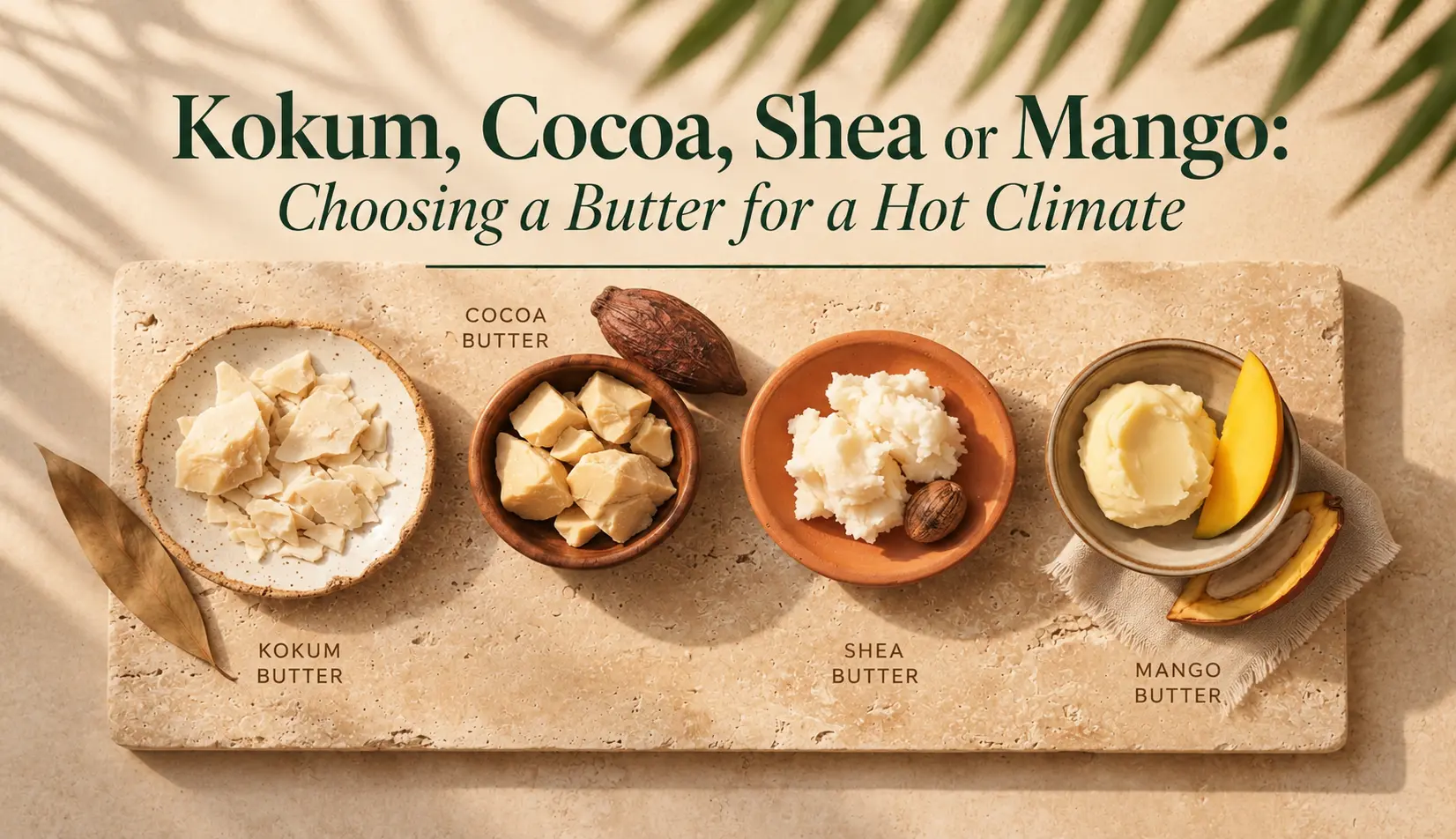
By the end of this post, you’ll know which butter, or blend of butters, suits a hot weather – and why changing the butter is only half the fix. We’re comparing four: kokum for structure, cocoa for richness, shea for creaminess and mango for balance.
Why Your Body Butter Melts – Even When You Bought the “Hard” One
You paid extra for the firmer butter, followed the recipe, and the jar still slumped on the dressing table. It feels like the ingredient lied to you.
It didn’t. Every butter has a melting range – the temperatures at which it moves from solid to soft to liquid. For our four, those ranges sit roughly between 30°C and 40°C, and they overlap a lot.
Now look at our weather. Long-term average daytime highs reach 35°C in Abuja in February and March, and 33°C in Lagos. In Kano, April averages 38°C. Those are averages for the open air: a parked car, a sunny windowsill or a closed delivery van can get even hotter.
There’s a second catch. A butter doesn’t wait for its melting point to start misbehaving. It’s a mix of different fats, so some soften before others. A whipped butter can lose its air and sink, a balm can sweat oil, and a product that melts and sets again can come back grainy.
What this means for your body butter jar: melting point and heat stability are two different things. A high melting number helps, but your whole formula has to hold its shape on a hot afternoon.
Meet the Four Butters – and the Job Each One Does Best
Standing in front of four tubs of butter can feel like choosing between cousins. They all look rich and promise soft skin, but they behave very differently once the heat arrives.
Kokum: the one that holds the structure
Kokum butter is the firm friend of the group. It’s hard, a little brittle, light on the skin and low in scent, which is why people often call it the hot-climate butter. The trade-off is stiffness – use too much and your butter turns crumbly and hard to scoop.
Cocoa: the one that brings richness
Cocoa butter is hard, rich and familiar. It leaves a more protective layer on the skin, and the unrefined kind brings its chocolate aroma along (deodorised versions exist if your customers don’t love it). It adds real firmness and starts softening at about the same point as kokum, but its range tops out a little lower.
Shea: the one that makes it creamy
Ori, okwuma, mai kadanya – you probably grew up with shea butter. It’s creamy, easy to whip and loved for good reason, with a smoky, nutty scent when unrefined. It’s also soft, so on its own it struggles with a hot afternoon.
Mango: the one that keeps the balance
Mango butter usually feels firmer than shea and softer than kokum, with a smooth finish and a mild, nutty smell (not the fruit). In a blend, think of it as the bridge between kokum’s stiffness and shea’s softness. Just don’t mistake that firmness for heat resistance.
Head to Head: Which Butter Copes Best With Heat?
This is the part to screenshot before your next batch.
| Butter | Approx. melting range (°C) | Firmness at room temperature | Skin feel | Scent (unrefined) | Whipping | Best job in a hot climate |
|---|---|---|---|---|---|---|
| Kokum | 34–40 | Hard, brittle | Light, less greasy | Very mild | Needs softer partners | Structure |
| Cocoa | 34–38 | Hard, brittle | Rich, protective | Chocolate | Needs softer partners | Richness plus firmness |
| Shea | 32–38 | Soft to medium | Rich, creamy | Smoky, nutty | Easy | Creaminess, with support |
| Mango | 30–37 | Medium | Smooth | Mild, nutty | Good | Balance, with support |
Ranges shift with batch, processing and test method. Kokum’s figure is its published slip melting point; the others come from the Elsie Organics product pages. Feel and whipping notes are general guides.
So is kokum really better than cocoa butter for hot weather? For firmness, it’s a strong choice. As an automatic one-for-one swap, no. Their ranges overlap, and swapping changes the texture, the scent and how the butter sets.
Shea and mango aren’t “bad” butters either. They simply need support – more hard butter, less liquid oil, a structuring ingredient or a different product format.
Fix the Formula, Not Just the Butter
So you swap shea for kokum and make a new batch. It holds up a bit better – and still turns soft by mid-afternoon. That’s the moment most of us realise the butter was only one lever.
The other big one is your butter-to-oil ratio. Liquid oils are already liquid, so the more you add, the less structure there is to hold everything up. If 75% butters and 25% oils keeps slumping, try 80:20 or 85:15 before you buy anything new.
When the ratio isn’t enough, bring in a structuring ingredient.
| Structuring option | What it does | The trade-off | A sensible first test |
|---|---|---|---|
| More kokum or cocoa | Adds firmness from the butter itself | Harder, more brittle scoop | Move 10% of the formula from soft to hard butter |
| Stearic acid | Stiffens with a creamy, less waxy feel | Too much feels heavy | 2–5% |
| Cetyl alcohol | Adds body with a silky feel | Gentler hardener than stearic acid | 2–5% |
| Beeswax or another wax | Firms strongly and helps resist heat | Can feel tacky or draggy | 2–5% |
These are starting points for testing, not guarantees. Take the percentage out of your liquid oil, change one thing at a time and write down what happens.
The sweet spot is a butter firm enough to survive the heat, yet soft enough to scoop and spread. So watch out for the wax stick trap. It’s tempting to keep adding wax until nothing melts, but then you’ve made a hard bar that drags across the skin. Your customer wanted a body butter, not a candle.
Try this before you sell: leave a labelled jar in your warmest room for a week and check it daily. Put a second one through an afternoon in a parked car. Whatever survives both has earned its place.
Why Your Butter Turned Grainy – and How to Keep It Smooth
One rub between your fingers and there it is: sand. Nothing smells off, but it no longer feels like the product you made.
Here’s what usually happened. Butters contain several fats that set at different speeds. When a melted butter cools slowly, some of them have time to gather into large crystals, which are the the grains you feel. In a supplier’s lab work on shea butter, faster setting gave smaller crystals and a smoother texture.
Heat can restart the problem weeks later. A jar that softens in transit and slowly sets again may arrive smooth-looking but gritty. Makers sometimes blame kokum, but shea, mango and cocoa blends can grain too.
To keep yours smooth:
- Melt gently and completely. Use a water bath and don’t overheat.
- Cool quickly and evenly. For shea or mango blends, stir over an ice bath or chill in the freezer for about 15 minutes until semi-solid, then whip. Don’t leave a big batch to cool slowly on the counter overnight.
- Test cocoa-heavy blends separately. Cocoa butter can set in several crystal forms, and some makers get smoother results with slower, controlled cooling or tempering.
- Check your oil partner. The same lab work warns that coconut oil can cause grains with shea. In its tests, sunflower oil also helped a hard shea fraction set faster than some lightweight cosmetic emollients did.
- Avoid repeat melting. Store finished jars somewhere with a steady, cool temperature.
Already grainy? Gently re-melt a water-free butter, then cool it quickly while stirring or whipping.
Formulator’s note: when kokum alone didn’t save the batch
One home maker shared her recipe on a soapmaking forum: 15 oz kokum, 15 oz shea, 5 oz rice bran oil and 5 oz meadowfoam oil, melted and poured without whipping. It turned grainy and began softening in a room of only about 24–26°C. She suspected the kokum was separating, though that wasn’t confirmed. The lesson: even a good share of a hard butter can’t rescue every formula.
Pick the Format That Can Survive Your Weather
Sometimes you’re fighting the heat with the one product that was never built for it. A cloud of whipped butter looks gorgeous on camera, then travels six hours in a hot vehicle.
- Whipped butter (water-free): the fluffiest and easiest to love on sight, but the most likely to collapse.
- Balm or solid bar: the best at surviving heat, though it gives a denser, slower experience on the skin.
- Cream or lotion: lighter, quicker to sink in and often the smartest choice for hot months. Because it contains water, it needs an emulsifier and a broad-spectrum preservative. It can still separate if badly formulated, so test it too.
What should you sell, and when?
| Months | Average daytime high, Abuja (°C) | Average daytime high, Lagos (°C) | Suggested lead product |
|---|---|---|---|
| November–January | 32–33 | 31–32 | Rich butters for harmattan dryness, firmed up and packed carefully |
| February–April | 34–35 | 32–33 | Balms, bars and creams |
| May–June | 29–31 | 29–31 | Creams, plus tested whipped butters |
| July–October | 28–31 | 28–30 | The kindest window for whipped butters |
Temperatures are long-term averages; product choices are suggestions. Check the weather where your parcel is going, not only where you made it.
Your Quick Decision Guide
It’s easy to freeze over a recipe because you want it scoopable, silky and unmeltable all at once. You can usually optimise for one or two of scooping, glide and delivery survival, but rarely all three – so choose your priority first.
| If you care most about… | Start with | Then adjust |
|---|---|---|
| Structure | Kokum | Soften with shea or mango if it crumbles |
| Richness | Cocoa | Add a softer butter or a little oil for easier spreading |
| Creaminess | Shea | Support it with kokum or cocoa |
| Balance and smooth feel | Mango | Add hard butter or a structurant for hot months |
| Easy scooping | Shea or mango, plus some hard butter | Increase oil slowly and re-test in heat |
| Better glide | A softer blend | Trim wax first |
| Surviving delivery | Kokum or cocoa, in a balm or bar | Cut liquid oil and test a structurant |
Then protect the work you’ve done:
- Store products in the coolest, darkest place you have. Below about 25°C is a good target, but even Abuja’s coolest months average daytime highs above that.
- Keep clear jars out of direct sunlight, or choose opaque ones.
- Shipping nationwide? Plan as though your parcel will meet temperatures above 35°C along the way, and use insulating liners where the cost makes sense.
- Send parcels early in the week so they don’t sit over a weekend.
- Ask customers to keep the parcel out of hot cars and let a softened jar set undisturbed in a cool place.
Frequently Asked Questions
It’s one of the best places to start when you need firmness with a light feel. Its published range reaches about 40°C against about 38°C for cocoa, though both can start melting at around 34°C. It still needs the right oil level, careful cooling and heat testing.
You can test it, but don’t expect an identical product. The scent, skin feel and texture will change, so make a small batch first.
Slow cooling, or melting and setting again, can let some fats form larger crystals. Re-melt a water-free butter gently, then cool it quickly while stirring.
Reduce the liquid oil first, then shift some soft butter to kokum or cocoa. If you still need help, test 2–5% stearic acid or cetyl alcohol before reaching for more wax.
Structure or Richness? Choose, Then Test
Remember that jar of oil in your cupboard? It wasn’t proof that you can’t make a good body butter. It was your formula telling you what it needed.
Here’s your pocket cheat sheet:
- Kokum gives structure.
- Cocoa gives richness.
- Shea gives creaminess.
- Mango gives balance.
The rest – your oil level, your cooling, your format and your packaging – decides whether the jar survives Nigerian heat.
When you’re ready to compare them side by side, each butter name above takes you to its page in our shop. Start small and let your own climate be the judge.
Now tell me: where do you live, what’s in your formula and what happens to it by afternoon? Share it in the comments.