
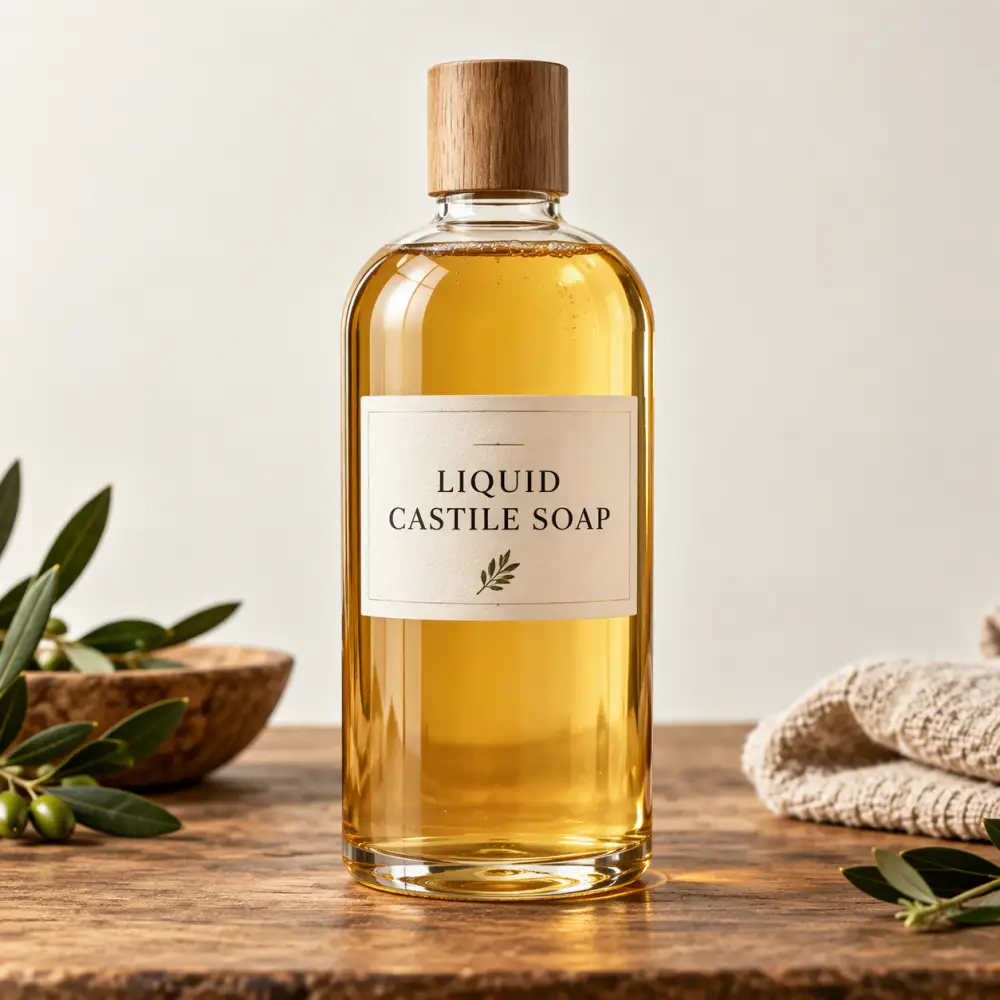
Pure Liquid Castile Soap (Sulfate-Free)
From ₦2,000.00Select size in litres to see the exact price.
Pure, unscented liquid Castile soap base. Gentle enough for daily use, and concentrated, so a little goes a long way. Use it neat, dilute it into foaming hand soap, or customise it into body and hand washes.
✓ No account needed. Add to cart → Checkout → Done.
Description
Liquid Castile Soap is a vegetable-oil-based true soap in ready-to-use liquid form – a ready-made unscented liquid soap for cleansing and DIY formulation. It’s a concentrated soap.
You can use it straight from the bottle (undiluted), dilute it, or customise it into your own liquid cleansing products. Castile Soap is ideal for home users, soap makers and beauty brands who want a liquid soap without making one from scratch.
Product Details
| Product name | Liquid Castile Soap |
| Type | Vegetable-oil-based true soap |
| Made from | Vegetable oils, water and potassium hydroxide (lye) |
| Form | Liquid |
| Colour | Amber |
| Odour | Unscented |
| pH | Typically 8.9 to 11 (alkaline) |
| Usage rate | 5% to 100% of total formula weight, depending on the product type (see usage guide) |
| Fragrance or essential oil | Typically, add 1% to 2% of total soap weight |
| Storage | Keep tightly sealed in a cool, dry place away from direct sunlight and heat |
Why Choose It
- Ready to use. No oils, lye or curing. Use it as supplied or build on it.
- Unscented. Leave it plain, or add a compatible fragrance.
- Versatile: Suitable for hand washing, body cleansing and liquid soap formulations.
- Saves development time. Skip the saponification stage and focus on your finished product.
- Works at any scale. Suitable for personal use, small-batch production and beauty businesses.
Usage Guide
Use these figures as starting points, then test and adjust for your own formulation.
| What you are making | Typical usage |
|---|---|
| Ready-to-use liquid soap | 50% to 100%. Use undiluted, or dilute with water or hydrosols to reach the thickness you want. |
| Body wash or hand wash (diluted) | About 15% to 30% liquid soap base, or use undiluted (100%). |
| Facial cleanser, shampoo or secondary cleanser | 1% to 30% as a cleansing base or secondary cleanser in your formula. |
| Foaming hand soap | 1 part soap to 3 to 4 parts water (1:3 to 1:4), which is roughly 20% to 25% soap. |
| Essential oils or fragrance | 1% to 2% of the total soap weight, after compatibility and dispersion testing. |
Formulation Tips
- Use distilled water: Always dilute with distilled or demineralised water. Minerals in tap water can cause cloudiness or react with the soap.
- Expect a thin liquid: Liquid castile soap is naturally thin because it is made with potassium hydroxide rather than sodium hydroxide.
- Salt will not thicken it: Standard salt solutions do not thicken pure castile soap the way they do synthetic surfactant bases. If you need a gel-like thickness, you will usually need a specialised thickener, such as Crothix Liquid, or a polymer modifier (such as Hydroxyethyl Cellulose (HEC), also known as Nitrosol. Test on a small batch first.
- Preserve diluted products. Once you add water, hydrosols or botanicals, the product needs suitable preservation. Hydrosols can also affect the pH and stability of a true soap.
Suitable Thickeners for Liquid Castile Soap: Crothix Liquid, HydroxyEthyl Cellulose (also known as Nitrosol), HPMC. Salt does not thicken it.
Common Uses of Liquid Castile Soap
1. Personal Use
- Hand wash: works well in pump dispensers
- Body wash: for bathing and showering
- Household cleaning: traditionally used for general cleaning. Follow suitable dilution guidance and test a small area first
2. Cleansing Products
- Liquid hand wash for home, hospitality or retail
- Liquid body wash
- Foaming hand wash
- Facial cleanser and shampoo bases
- Fragranced liquid soap, adding compatible fragrance or essential oils
- Botanical liquid cleanser, adding compatible extracts
- Small-batch liquid soap for your brand
Customisation Notes
Liquid Castile Soap is a true soap, made by saponifying oils. What that means:
- It is alkaline: With a pH typically between 8.9 and 11, it can become unstable or separate when mixed with acidic ingredients.
- It is not a synthetic detergent base: It is not interchangeable with surfactant systems designed for low-pH formulas.
- Not every additive is compatible: Test fragrances, essential oils, botanicals and oils for dispersion and clarity before scaling up.
Plan to customise it to sell? Before selling any customised product made from your Liquid Castile Soap, check:
- Ingredient compatibility
- Final pH, viscosity and stability
- Preservation, especially if you add water, hydrosols or botanicals
- Dispersion of fragrance or essential oils
- A small test batch before full production
Storage and Handling
Keep tightly sealed when not in use, in a cool, dry place away from direct sunlight and excessive heat. Use clean dispensing equipment and avoid getting water or contaminants into the original container.
Frequently Asked Questions (FAQs)
What is Liquid Castile Soap?
A vegetable-oil-based true soap in liquid form. Traditionally, Castile soap was made with only olive oil. Today, makers around the world use other oils too, so you will find versions made from olive oil blended with other oils, from a mix of non-olive oils, or from a single other oil.
What is it made from?
A blend of vegetable oils (including coconut oil, sunflower), water and potassium hydroxide (lye). Potassium hydroxide is the alkali that turns the oils into a liquid soap.
How much should I use in a formulation?
It depends on the product. Use 50% to 100% for a ready-to-use liquid soap, about 15% to 30% for a diluted body wash or hand wash, and 1% to 30% as a cleansing base in facial cleansers and shampoos. Always test your own formulation.
How do I make foaming hand soap?
Mix 1 part Liquid Castile Soap with 3 to 4 parts water (roughly 20% to 25% soap), then pour into a foaming dispenser. Use distilled water and adjust the ratio to suit your dispenser.
How much essential oil or fragrance can I add?
Typically 1% to 2% of the total soap weight. Test for dispersion first, as not every fragrance mixes evenly into a true soap.
Why should I use distilled water?
Minerals in tap water can make castile soap cloudy or react with it. Distilled or demineralised water gives a clearer, more stable result.
Can I thicken it with salt?
Not effectively. Salt thickens synthetic surfactant bases, but it does not work well on pure castile soap. For a gel-like texture, you will usually need a specialised thickener such as Crothix or a polymer modifier such as Hydroethyl Cellulose (HEC).
Can I use it straight from the bottle?
Yes. It is supplied ready to use for suitable cleansing applications.
Can I use it as a soap base?
Yes. It works as a starting point for liquid hand wash, body wash and similar products, depending on ingredient compatibility.
Is it the same as a liquid detergent base?
No. Castile soap is a true soap made by saponification. Many commercial liquid bases use synthetic surfactants, and the two behave differently in formulation.
What is the pH of Castile soap?
Typically between 8.9 and 11, which makes it alkaline.
What is the difference between Castile and Bastille soap?
Strictly speaking, traditional Castile soap is made only from olive oil. Bastille is an olive-oil-dominant soap that also includes other vegetable oils such as coconut or palm. “Bastille” is an artisan term with no fixed standard percentage. In everyday use, many makers now label non-olive and mixed-oil soaps as Castile too.
Does Castile soap come in other forms?
Yes: solid bars, liquid soap and soft paste. The form depends mainly on the alkali used. Sodium hydroxide typically makes hard bars, and potassium hydroxide typically makes liquid and soft soap.
Who is it for?
DIY makers, soap makers, cosmetic formulators and beauty businesses.
Do you deliver in Nigeria?
Yes. We deliver nationwide.
A Short History of Castile Soap
Castile soap is named after Castile, a historic region of Spain known for its olive-oil soap. Its exact origins are hard to pin down. Olive-oil soapmaking has a long Mediterranean history, and Aleppo soap from Syria is an older example.
Traditionally, Castile soap was made with only olive oil, largely because olive oil was so abundant in the region where it was first made. Olive oil is rich in oleic acid, which gives a relatively mild soap with a dense, creamy lather.
Today, makers around the world substitute other oils. Some use a mix of olive oil and other oils, some use a mix without olive oil, and some use a single other oil. Coconut oil is a popular addition because its lauric and myristic acids boost lather and cleansing. In simple terms, olive oil gives creaminess and coconut oil gives bubbles.
Buy Liquid Castile Soap in Nigeria
Elsie Organics makes sourcing cosmetic raw materials easier for DIY makers, formulators and beauty businesses. Order online with nationwide delivery across Nigeria, and explore our carrier oils, butters, Ayurvedic herbs and other formulation ingredients.
Shop Liquid Castile Soap at elsieorganics.com
Only logged in customers who have purchased this product may leave a review.
You may also like…
- Cosmetic Ingredients, Liquid Ingredients
Vegetable Glycerin (Glycerol) for Skin, Hair and DIY Formulations
- From ₦1,500.00
- Select options This product has multiple variants. The options may be chosen on the product page
- Oils, Oils & Butters
Golden Jojoba Oil (Unrefined, Cold Pressed)
- From ₦2,200.00
- Select options This product has multiple variants. The options may be chosen on the product page
- Oils, Oils & Butters
Sweet Almond Oil (Cold-Pressed) for Skincare & Haircare
- From ₦1,300.00
- Select options This product has multiple variants. The options may be chosen on the product page


Related products
- Colourants, Micas, Soap Making Ingredients
Golden Yellow Mica Powder (Colourant)
- From ₦1,000.00
- Select options This product has multiple variants. The options may be chosen on the product page
- Soap Bases
Ghana Green Soap Balls (Whitening Balls/ Anti-Reaction Soaps)
- ₦1,200.00
- Select options This product has multiple variants. The options may be chosen on the product page
- Colourants, Micas, Soap Making Ingredients
Magic Yellow Mica Powder (Colourant)
- From ₦1,000.00
- Select options This product has multiple variants. The options may be chosen on the product page


Reviews
There are no reviews yet.